

News and Trends
Utility Room CO Detector, WANLIN-365, Jurong
TL;DR: Wanlin Extends the CO Line to Jurong Boiler Rooms and Parking Decks
Wanlin extends the co line to boiler rooms, plant rooms and parking decks for Jurong and Singapore landlords, letting agents, housing associations, hotel and serviced apartment groups, student and senior housing operators, boiler and plant room operators, parking deck managers, RV, camper, caravan and marine builders, gas and heating contractors, safety distributors, electrical wholesalers, importers, trading companies and sourcing agents. Carbon monoxide is the risk a smoke alarm cannot see: it has no smell, no colour and no taste, it comes from any fuel-burning appliance that is poorly installed, poorly maintained or poorly flued, and it hurts the people who are asleep when it arrives. The Wanlin CO line is built around the two things that actually decide the outcome - the response curve and the alert path. Electrochemical and MEMS CO sensing declared to the EN 50291-1 time-weighted response bands and the UL 2034 bands for North America, sealed 10-year lithium cells with a declared end-of-life date, plug-in, mains and 12 V or 24 V DC variants, LCD display, voice alert and strobe output, combination smoke and CO units, and interconnection or cloud alerting over RF 433 MHz, Wi-Fi, Zigbee, Z-Wave, 4G, NB-IoT and LoRaWAN so an event in the basement sounds the unit outside the bedroom and reaches a phone. The WANLIN wireless device family - WANLIN-365 Gas Detector (LoRa / 4G / 433) among them - rides on the same host where a site wants CO, smoke, gas and plant monitoring under one account. Every shipment leaves with CE, RoHS and REACH files, FCC where the destination requires it, EN 50291-1 and EN 50291-2 documentation, UL 2034 and CSA documentation for the Americas, calibration records per lot against reference CO mixtures and a commissioning record from the Jurong test floor. OEM/ODM with private label, factory-direct export supply for Jurong and Singapore, and an open distributor, contractor and agent programme for 2026-2027.
Featured WANLIN device this report: WANLIN-365 Gas Detector (LoRa / 4G / 433) - 433 MHz gas configuration — 433 MHz RF link to the local host or the interconnected group for single-building kitchen and utility room projects; sensing and method Catalytic bead sensor for methane and LPG to 100 percent LEL, NDIR infrared option for long life, electrochemical CO cell per EN 50194 and EN 50291; output and signalling 85 dB(A) sounder, red / amber / green tri-colour LED, relay and solenoid valve drive output for gas shut-off; connectivity LoRaWAN, 4G Cat-1 or 433 MHz uplink with standalone relay output or RS-485 Modbus at the device; mounting Wall or ceiling mount on 60 mm fixing centres, 1 m or 3 m lead for the remote sensor head, conduit entry; ingress protection IP42 indoor and IP65 plant-room variants, operating -10 to +55 C, 15-90 percent RH; enclosure ABS V-0 white housing, 120 x 80 x 42 mm, 210 g, chemical-resistant grade for kitchens; indication Tri-colour status LED, four-digit display on the CO variant, single test / reset button; extra features Pre-alarm and main alarm thresholds, solenoid valve drive, self-diagnostics with end-of-life flag, remote alarm and valve status to the cloud; warranty and after-sales 3-year limited warranty, annual calibration reminder, 30-day DOA replacement; in the box Detector, fixing kit, 1 m sensor lead where applicable, calibration cap, test gas instructions, multi-language manual EN/ES/FR/DE/IT. Full component data sheet below.
Published by Wanlin Manufacturing Group (Wanlin Brand) | Last updated: September 22, 2026 | Expertise: 15+ years fire detection, gas detection, instrumentation and building safety device manufacturing and export
Dispatch note for Jurong: Singapore-bound consignments leave Shenzhen via PSA Singapore (Pasir Panjang and Tuas) for global transshipment into Southeast Asia, with regional bonded warehousing in Jurong and Woodlands and same-day trucking across the Causeway into Malaysia. Alarms, mounting plates, fixings, accessories, spares and the country documentation folder are consolidated at the factory before sailing; typical door-to-door lead time for Singapore runs 19-25 days after the batch clears pre-shipment inspection, with sample cartons shipped by air inside 10-15 days for partners who want to test one building before committing to a programme.
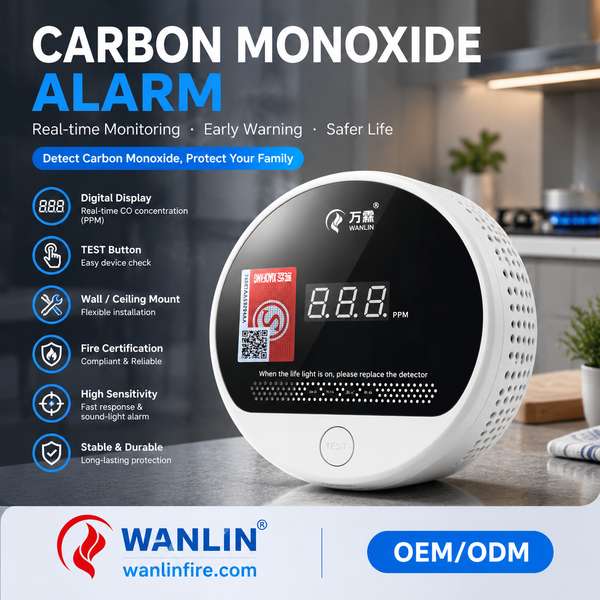
About Wanlin: Chinese Carbon Monoxide Alarm Manufacturer and Export Supplier
Wanlin is the fire protection and building safety products brand of Wanlin Manufacturing Group, a 15-year Chinese manufacturer headquartered in Shenzhen, China. The brand builds the carbon monoxide detection line - dedicated CO alarms and CO detectors, combination smoke and CO units, CO and combustible gas units, the electrochemical and MEMS sensing channels behind them, the sealed-cell and low-voltage power options, the wireless and cellular alerting paths and the cloud fleet layer - for landlords and letting agents, housing associations, hotel and serviced apartment groups, student and senior housing operators, boiler and plant room operators, parking deck managers, RV, camper, caravan and marine builders, gas and heating contractors, safety distributors, electrical wholesalers, importers, trading companies and sourcing agents across Jurong, Singapore and more than 60 export markets.
Wanlin operates a genuine source factory with in-house injection molding, SMT PCB assembly, electrochemical sensor calibration tunnels with reference CO mixture delivery, semiconductor and MEMS exposure chambers, environmental chambers for humidity, temperature and salt-spray cycling, battery consumption rigs, anechoic sound measurement for the alerting path, radio link test beds and a live functional test line. Our factory builds the complete CO detection line and the WANLIN wireless device family around it - all configurations supported by CE marking with the EMC and radio equipment directives where a radio link is fitted, RoHS and REACH material files, FCC certification for the US with FCC Part 15 on the radio options, UL 2034 for the residential CO alarm and UL or ETL listing where the authority having jurisdiction asks for it, CSA 6.19 for Canada, UKCA for Great Britain, EN 50291-1 for household CO alarms and EN 50291-2 for caravan, leisure accommodation craft and marine use, EN 14604 where a combined smoke channel is fitted, EN 50194 for the combustible gas channel on combination units, NFPA 720 and the CO detection provisions carried in NFPA 72 for the Americas, BS 5839-6 for British residential practice, AS references for Australia and New Zealand with RCM, IECEx and ATEX documentation where a CO channel is specified into a hazardous area, EAC and GOST for the Eurasian customs union, KC for Korea, PSE for Japan, CCCF for the Chinese domestic fire market, SASO and SABER support for Saudi Arabia, TISI for Thailand, SNI for Indonesia, SIRIM for Malaysia, DTI-BPS and BFP for the Philippines, BIS for India, SABS for South Africa, NOM for Mexico, INMETRO for Brazil, NIST-traceable calibration records per production lot against reference CO mixtures, ISO 9001 and ISO 14001 factory systems, OEM/ODM and private label, custom colour and logo programs, private-label packaging, multi-language manuals (English / Arabic / Russian / Spanish / French / Portuguese / Indonesian / Urdu / Hindi / Vietnamese / Thai), and spares and consumables programs sized to each partner's annual project volume.
Inside the Wanlin CO Detection Stack: Sensing, Power, Alerting, Compliance and Fleet
A CO alarm is a deceptively simple product to specify badly. The sensing element, the power source, the alerting method, the siting rule and the end-of-life behaviour each make or break the outcome, and they interact: a sealed cell changes the replacement cycle, interconnection changes whether anyone hears the alarm, and a mains unit with a relay output changes what the building does about it. The table below is the stack in the order a Jurong buyer should read it.
| Layer | What it decides | Field data from the Jurong programme |
|---|---|---|
| Sensing element | Electrochemical cells for the residential and commercial CO channel, with MEMS and semiconductor options where a programme is optimised for cost or for a gas channel as well; the cell chemistry decides the cross-interference behaviour and the service life | Reference CO mixtures alarmed inside the declared time band at every concentration step; hydrogen, ethanol and cleaner vapour logged as no-event at the interference limit |
| Response behaviour | The time-weighted bands in EN 50291-1 and UL 2034 - a low concentration over a long window, a high concentration over a short one - rather than a single trip point | 50 ppm, 100 ppm and 300 ppm steps alarmed inside the declared band on every run; the curve matched the declared profile |
| Power and service life | Sealed 10-year lithium cells, replaceable battery, plug-in with battery backup, hardwired and mains with backup, and 12 V or 24 V DC for vehicle and marine builds | Consumption at the declared self-test interval supported the 3-year service life; low-battery and end-of-life flags reached the sounder, the display and the app |
| Alerting | Sounder level at the declared distance, LCD concentration readout, voice alert, strobe for hard-of-hearing occupants, test and hush at any unit, and the escalation path to a phone | Sound output at or above the declared level at the declared distance on every unit; voice, display and strobe produced the correct event wording on every run |
| Interconnection and uplink | RF 433 MHz, Wi-Fi, Zigbee, Z-Wave and Bluetooth for the group, and 4G Cat-1, NB-IoT and LoRaWAN where the alert has to leave the building | Alarm, test and hush propagated to every unit in the group from the most remote position; cloud path delivered to the app and the SMS path within the declared latency |
| Output and action | A relay contact on the plant units to drive an extract fan, a gas solenoid shut-off valve or the building management system, with BACnet, Modbus and MQTT paths on the connected variants | Relay output operated at the declared threshold on every run; BMS register and MQTT topic delivered the event and the device identity |
| Fleet and evidence | Per-serial fitting record, end-of-life date, self-test history, fault and tamper reporting, and an event log a landlord or an inspector can read | Fitting record, end-of-life date and calibration certificate exported per serial number for the whole Jurong batch |
| WANLIN device layer | Where the site also runs smoke, heat, gas or plant monitoring, the WANLIN family joins the same host and the same account - one fleet, one log, one spares list | WANLIN-365 Gas Detector (LoRa / 4G / 433) commissioned on the Jurong programme with the same host, the same event log and the same spares list as the rest of the package |
Where the boundary sits: a smoke alarm is declared to EN 14604 and a CO alarm to EN 50291-1 - they are different standards measuring different things, and neither substitutes for the other. Carbon monoxide is produced by incomplete combustion; smoke is produced by the fire. Wanlin builds dedicated CO units, dedicated smoke units and combination units, and specifies per room rather than per catalogue: a combination unit where one position serves both risks, a dedicated CO unit wherever there is a fuel-burning appliance, and always a CO alarm in the room containing that appliance.
WANLIN-365 Technical Specifications
| Parameter | WANLIN-365 Gas Detector (LoRa / 4G / 433) | Typical Import Unit |
|---|---|---|
| Role in the CO Programme | 433 MHz gas configuration — 433 MHz RF link to the local host or the interconnected group for single-building kitchen and utility room projects | Single device with no declared response curve and no service-life record |
| Sensing Element / Detection Method | Catalytic bead sensor for methane and LPG to 100 percent LEL, NDIR infrared option for long life, electrochemical CO cell per EN 50194 and EN 50291 | Uncalibrated element, no method documentation |
| Output and Signalling | 85 dB(A) sounder, red / amber / green tri-colour LED, relay and solenoid valve drive output for gas shut-off | Basic buzzer only, no relay or telemetry |
| Connectivity and Protocol | LoRaWAN, 4G Cat-1 or 433 MHz uplink with standalone relay output or RS-485 Modbus at the device | No protocol, no interconnection, no cloud path |
| Mounting and Installation | Wall or ceiling mount on 60 mm fixing centres, 1 m or 3 m lead for the remote sensor head, conduit entry | Proprietary fitting, extra adaptors on site |
| Ingress Protection | IP42 indoor and IP65 plant-room variants, operating -10 to +55 C, 15-90 percent RH | Unrated enclosure, dry indoor areas only |
| Enclosure and Material | ABS V-0 white housing, 120 x 80 x 42 mm, 210 g, chemical-resistant grade for kitchens | Recycled plastic, unknown flame rating |
| Indication and Interface | Tri-colour status LED, four-digit display on the CO variant, single test / reset button | Single LED, no test or hush control |
| Extra Features | Pre-alarm and main alarm thresholds, solenoid valve drive, self-diagnostics with end-of-life flag, remote alarm and valve status to the cloud | None |
| Certification and Compliance | CE marking with the EMC and radio equipment directives where a radio link is fitted, RoHS and REACH material files, FCC certification for the US with FCC Part 15 on the radio options, UL 2034 for the residential CO alarm and UL or ETL listing where the authority having jurisdiction asks for it, CSA 6.19 for Canada, UKCA for Great Britain, EN 50291-1 for household CO alarms and EN 50291-2 for caravan, leisure accommodation craft and marine use, EN 14604 where a combined smoke channel is fitted, EN 50194 for the combustible gas channel on combination units, NFPA 720 and the CO detection provisions carried in NFPA 72 for the Americas, BS 5839-6 for British residential practice, AS references for Australia and New Zealand with RCM, IECEx and ATEX documentation where a CO channel is specified into a hazardous area, EAC and GOST for the Eurasian customs union, KC for Korea, PSE for Japan, CCCF for the Chinese domestic fire market, SASO and SABER support for Saudi Arabia, TISI for Thailand, SNI for Indonesia, SIRIM for Malaysia, DTI-BPS and BFP for the Philippines, BIS for India, SABS for South Africa, NOM for Mexico, INMETRO for Brazil, NIST-traceable calibration records per production lot against reference CO mixtures, ISO 9001 and ISO 14001 factory systems, OEM/ODM and private label | Incomplete or missing |
| Warranty and After-Sales | 3-year limited warranty, annual calibration reminder, 30-day DOA replacement | No spares path, no documentation support |
| Ships in the Box | Detector, fixing kit, 1 m sensor lead where applicable, calibration cap, test gas instructions, multi-language manual EN/ES/FR/DE/IT | Unit only, no fixings or documentation |
Supply terms: Factory-direct pricing | OEM/ODM and private label | Cartons packed by dwelling, by block or by phase | CE, RoHS, REACH, FCC, UKCA, CSA, UL 2034 and EN documentation with every order | Custom colours, logo printing and carton branding | Spares and replacement-cell programs sized to your annual volume | Platform accounts and API access provisioned before shipment | Sea freight via PSA Singapore (Pasir Panjang and Tuas) for global transshipment into Southeast Asia, with regional bonded warehousing in Jurong and Woodlands and same-day trucking across the Causeway into Malaysia, plus air options for sample cartons and urgent top-ups | Warranty and after-sales spare parts program.
Featured programme profile this report - Landlord and Rental Compliance Profile (Fit, Forget, Prove): the configuration most Jurong landlords, letting agents and housing associations start with: one sealed 10-year CO alarm per dwelling with a fuel-burning appliance, plus one in the room housing the appliance, delivered with a fitting record and an end-of-life date per serial number Compliance is a paper trail before it is a device. A landlord does not want to remember which unit was fitted in which year, so the record has to be issued with the order: serial number, room, fitting date, replacement date.
CO Alarm, Smoke Alarm, Gas Alarm: Where the Boundary Actually Sits
This is the distinction the Jurong export desk spends the most time on, and getting it wrong is how a building ends up compliant on paper and unprotected in fact. The three channels measure three different things, they are declared to three different standards, and they sit in three different places in a room. The table below is how we draw the line before a specification is written.
| Question | Smoke alarm (EN 14604) | CO alarm (EN 50291-1) | Combustible gas (EN 50194) |
|---|---|---|---|
| What it detects | Visible and invisible combustion particles in the air | Carbon monoxide, a gas produced by incomplete combustion, with no smell, colour or taste | Methane, LPG and other combustible gases from a leak rather than from combustion |
| Why it exists | Life safety: raise the alarm and get out | Life safety against a poison that gives no warning cue at all | Explosion prevention: shut the supply and ventilate before an ignitable mixture forms |
| Response model | Threshold on the chamber signal, as fast as the standard allows | Time-weighted bands: a low concentration over a long window, a high concentration over a short one | Percentage of the lower explosive limit, typically with a valve drive output |
| Where it is fitted | Ceiling, in the circulation space and in the rooms | In the room with the fuel-burning appliance and outside the sleeping accommodation, at breathing height or on the ceiling - not in a dead-air corner and not directly above a hob | High for a gas lighter than air, low for a gas heavier than air, near the supply |
| What replaces what | Nothing. A smoke alarm does not detect carbon monoxide | Nothing. A CO alarm does not detect smoke or fire | Nothing. A gas alarm does not detect the products of combustion |
| When a combination unit is right | A combination smoke and CO unit is a fitting decision rather than a compromise: one housing, one plate, one battery, one end-of-life date and one visit instead of two. It is the right answer where a single position serves both risks - a hallway outside both a kitchen and a bedroom, for example - and the wrong answer where the appliance room and the sleeping accommodation are far apart, because each sensor wants its own position. | ||
In one line: smoke tells you a fire has started, carbon monoxide tells you something is burning incompletely and poisoning the room, and gas tells you the supply is leaking. Wanlin builds all three channels and specifies them per room, with the combination unit used where it genuinely fits and dedicated units used everywhere else.
Competitive Comparison: Wanlin vs Other CO Alarm Sources
| Supplier type | Advantages | Disadvantages |
|---|---|---|
| Wanlin (Factory Direct) | 15-year manufacturer; the electrochemical cell supply, the enclosure, the radio, the firmware and the calibration tunnel sit in one factory, so the response curve, the interference behaviour and the service-life claim stay consistent across lots; sealed 10-year, plug-in, mains, hardwired and 12 V or 24 V DC variants from one catalogue; combination smoke and CO units and a combustible gas channel alongside; OEM from low four-figure unit quantities with custom colours, logo printing and carton branding; CE, RoHS, REACH, FCC, UKCA, CSA, UL 2034 and EN 50291 documentation with every shipment; 30-50 percent below brand-equivalent pricing; distributor, contractor and agent programme with territory discussion | Newer brand recognition in retail channels where the incumbent consumer brands - Kidde, First Alert, BRK, Nest, X-Sense, Ei Electronics, Aico and FireAngel among them - have decades of shelf familiarity |
| Incumbent Retail and Consumer Brands | Strong consumer recognition, mature retail distribution, established warranty and recall infrastructure, and a service network the buyer already knows how to call | Premium pricing across the catalogue, closed app ecosystems, limited or no private-label and OEM hardware programmes, and often a single power configuration per market - which is exactly why Singapore distributors and contractors benchmark the Wanlin line against them for programme and project volume |
| Regional Importers and Local Resellers | Fast delivery from local stock, familiar invoicing, local-language support and a returns desk the buyer can visit | No factory calibration data, no declared response curve, no consolidated certification pack, no spares programme, quality variance between lots, no OEM path for their own brand and no ability to change a self-test interval or a relay behaviour at the source |
| Generic Wholesale Spot Buys (marketplace-style) | Lowest unit price on single-carton orders and immediate availability | No EN 50291 or UL 2034 file, undocumented cell chemistry, no cross-interference data, no declared service life, no warranty service and no spares - and a CO alarm that nuisance-alarms or goes silent is removed within a month, which leaves the room unprotected rather than merely under-equipped |
| Security and Smart-Home Platforms | Polished app experience, integration with a wider automation estate and a strong consumer brand | Hardware is usually sourced rather than built, so the sensing element, cell chemistry and service life vary by generation; closed protocols lock the service and the data to the platform; limited plant-room, DC and relay-output configurations for the commercial and vehicle side of the category |
Sizing and Siting Guide: How a Jurong Site Specifies CO Detection
Sizing a CO programme is a room question before it is a device question: the first decision is which rooms contain a fuel-burning appliance, the second is where the occupants sleep, and the third is how the alarm gets from one to the other. The reference schedule below is the one the Jurong export desk issues after a site survey, based on what partners actually deploy.
| Site type | Where the units go | Typical device count | Recommended configuration |
|---|---|---|---|
| Single dwelling or apartment (up to 3 rooms with an appliance) | One in the room with the appliance, one in the hall or landing outside the bedrooms, one on each further floor | 2 to 4 | Sealed 10-year battery CO alarms, RF or Wi-Fi interconnection, hush and test at any unit, no cabling |
| House, townhouse or multi-family unit (up to 24 positions) | Appliance rooms, hallways, living rooms with a solid-fuel stove, bedroom level | 4 to 8 | Interconnected sealed-cell units, combination smoke and CO units in the circulation spaces, dedicated CO units in the appliance rooms |
| Hotel, motel or hostel (up to 48 rooms) | Guest rooms with a gas appliance or a shared flue, corridors, boiler room, laundry and kitchen | 48 to 70 | Sealed-cell units in the rooms, mains units with a relay output in the plant areas, cloud account per property with per-device status |
| Student housing or dormitory block (up to 90 rooms) | Each study bedroom with an appliance, corridor level, plant room | 90 to 130 | Interconnected units per floor with tamper and end-of-life reporting, plant-room units with a relay output, per-building dashboard |
| Senior living, nursing home or care facility (up to 160 positions) | Resident rooms, corridors, laundry, boiler room, staff areas | 150 to 210 | Units with voice alert and strobe output, interconnected per wing, escalation to the nursing station, end-of-life reporting into the maintenance system |
| Boiler room, plant room, generator room or enclosed parking deck | Breathing height near the appliance or the deck, away from the door swing and the extract intake | Per survey | Mains or 24 V units with a relay output driving an extract fan or a gas solenoid valve, IP65 or IP67 housings, wide-temperature range, BACnet or Modbus to the BMS |
| RV, camper, caravan or small craft | Sleeping area and near the cooking or heating appliance, inside the cabin envelope | 1 to 2 per vehicle | 12 V or 24 V DC units with a wide-temperature range and vibration-tolerant mounting, flush-mount housing, EN 50291-2 documentation route |
Worked example for a 12-unit Jurong site: roughly 16 alarms across appliance rooms, circulation spaces and sleeping levels, a CO event raised inside the declared response band at 50, 100 and 300 ppm at the default sensitivity, and a nuisance margin validated against 6 interferents found on the site before the sensitivity and siting plan is signed off. Power on this profile is specified for a 3-year service life at the declared self-test interval, with end-of-life, fault and tamper reporting so a unit that has been taken down or has expired is found by the record rather than by luck. Siting follows the rule of thumb the survey issues with the schedule: in the room containing the appliance, outside the sleeping accommodation, at breathing height or on the ceiling, not in a dead-air corner, not directly above a hob and not beside an extract intake. These are indicative figures for budgeting - the issued room schedule, siting plan and device list follow the site survey and the operator's own obligations, and those are the numbers that go into the Singapore submission pack.
Inside the Compliance Stack: EN 50291-1, EN 50291-2, UL 2034, CSA 6.19 and the National Marks
A CO alarm programme clears a tender on paper before it clears a building. The submission has to show what the alarm is declared against in the destination market, what the radio approval is where a radio link is fitted, what the calibration and test records say and what the factory's quality system is. The table below is the stack the Jurong documentation pack is built around; the certificate set and the manual in the language the inspector reads ship inside the shipment folder.
| Standard / approval | Status on the Wanlin CO line | What it enables for Jurong buyers |
|---|---|---|
| EN 50291-1 (household CO alarms) | Declared with the type-test report covering the time-weighted response bands, the interference resistance, the sound output and the end-of-life behaviour | The document a European specifier, landlord or housing provider names first; the response curve and the interference data come with it rather than after it |
| EN 50291-2 (caravan, leisure accommodation and marine) | Declared on the 12 V and 24 V DC leisure and marine configurations, including the vibration and wide-temperature behaviour | Vehicle converters, caravan builders and boat builders get the route their own type approval expects instead of a domestic unit adapted to a cabin |
| UL 2034 and CSA 6.19 | UL 2034 documentation for the US residential CO alarm with UL or ETL listing where the authority having jurisdiction asks for it, and CSA for Canada | North American buyers get the document set their own compliance team, insurer and inspector already read |
| EN 14604 and EN 50194 | EN 14604 where a combined smoke channel is fitted, EN 50194 for the combustible gas channel on combination units | One certificate folder covers the combination unit instead of two parallel files from two suppliers |
| CE marking, RoHS and REACH | EMC and radio equipment directives where a radio link is fitted, RoHS and REACH material declarations held per model | The consignment clears at the port on first presentation, and retail and healthcare buyers who screen substances before price are satisfied |
| FCC and FCC Part 15 | FCC certification for the US with Part 15 on the Wi-Fi, Zigbee, Z-Wave, Bluetooth and cellular radio options | The connected variants can be registered and sold in the US without re-opening the radio file |
| NFPA 720 and NFPA 72, BS 5839-6, IFC | Installation, siting and maintenance documentation referenced for the Americas and British practice | The installer can show the authority which rule the device schedule was drawn against, which is what a code inspection actually asks |
| National marks and market approvals | UKCA for Great Britain, RCM for Australia and New Zealand, EAC and GOST for the Eurasian customs union, KC, PSE, CCCF, SASO and SABER, TISI, SNI, SIRIM, DTI-BPS and BFP, BIS, SABS, NOM, INMETRO, and SBC 801 support for Saudi projects | A distributor can register the line in its own market without starting a new factory file |
| Factory quality systems | ISO 9001 and ISO 14001, NIST-traceable calibration records per lot against reference CO mixtures, sensor calibration tunnels, environmental cycling, battery consumption rigs and sound measurement | Documented, per-serial evidence for landlords, insurers, education authorities and public procurement reviews |
Global Carbon Monoxide Detection Market Trends
CEN and CENELEC publish EN 50291-1 for household carbon monoxide alarms and EN 50291-2 for carbon monoxide alarms in caravans, leisure accommodation vehicles and boats. The standard defines the time-weighted response bands the device has to meet rather than a single trip point, which is why a serious buyer asks for the response curve and not merely the mark on the carton. CEN and CENELEC
- Buyers now ask for the response curve before the certificate: EN 50291-1 and UL 2034 both specify time-weighted response bands, not a single trip concentration: low concentration over a long window, higher concentration over a short one. A distributor who has been asked twice why an alarm stayed silent during a slow accumulation stops asking for the mark on the carton and starts asking for the curve, and the factory that can publish the curve per lot wins the second container.
- Vehicle, marine and off-grid programmes pulled the category into 12 V and 24 V DC: RV converters, camper builders, caravan manufacturers and boat builders need CO detection on a low-voltage DC supply with a wide temperature range and a housing that survives vibration. EN 50291-2 exists for leisure accommodation and marine use precisely because a vehicle cabin is not a house, and the suppliers who treat it as a house end up with units that nuisance-alarm or drop out on the first cold night.
- The sealed 10-year cell became the default expectation: A replaceable-battery alarm is a maintenance obligation the occupant does not honour: the unit gets removed when the chirp starts, and the unit that gets removed is the one that was protecting the room. A sealed cell with a declared end-of-life date converts that obligation into a replacement cycle that a landlord, a hotel group or a housing association can actually plan, which is why the 10-year configuration now carries most of the professional volume.
Source: CEN and CENELEC
Partner Success Story: Vehicle Converter, Caravan and Marine Builder (12 V / 24 V DC Programme)
Partner: An RV converter, camper and caravan manufacturer and a small craft builder supplying Jurong and the regional leisure market, integrating CO detection into the vehicle electrical system.
Deployed: 12 V and 24 V DC CO alarms, wide-temperature range, flush-mount housing, EN 50291-2 documentation route, Singapore-focused configuration with local-language manuals, CE, RoHS, REACH, FCC and EN 50291 documentation packs, platform accounts provisioned at the factory and a spares programme sized to the partner's annual volume
Timeline: First production batch shipped 19-25 days after sample approval; the partner's crews commissioned 360 units and positions across the first season, with siting schedules and end-of-life records pre-loaded before delivery
| Metric | Result |
|---|---|
| Documentation acceptance | The consolidated CE, RoHS, REACH, FCC and EN 50291 pack cleared the partner's compliance review on first submission - the same file was attached to the next three tenders without rework |
| End-of-life exposure | Per-serial end-of-life dates replaced the annual walkaround: units reaching the end of their declared service life were identified by the record and replaced inside the planned window rather than discovered at changeover |
| Alert discipline | Interconnection and cloud alerting turned a local sounder into a notified event: an alarm in an appliance room reached the responsible person's phone with a device identity and a room attribution |
| Project economics | One engineered package with a spares programme priced for the season landed 30-40 percent below the brand-equivalent benchmark, which is what let the partner win the second building |
"The builder had been fitting domestic units and getting nuisance alarms and low-voltage dropouts on cold nights. Wanlin supplied 12 V and 24 V DC units with a wide-temperature range and vibration-tolerant mounting, documented on the EN 50291-2 route for leisure accommodation and marine use, with a flush-mount housing that suited the interior trim." - Representative, Singapore Program Partner
Field Report: Wireless Interconnection Through Walls, Decks and Cabinets - Jurong
Location: Wanlin fire protection products test floor, Longgang District, Shenzhen, China
Date: August 7, 2026 | Ambient: 27 C, 63 percent humidity | Equipment under test: WANLIN-365 Gas Detector (LoRa / 4G / 433) (433 MHz gas configuration — 433 MHz RF link to the local host or the interconnected group for single-building kitchen and utility room projects) with the CO detection package
Interconnected units from the Jurong lot were installed across a test building with masonry walls, a closed door set, a kitchen cabinet run and a basement stair between them, over RF 433 MHz, Wi-Fi, Zigbee and Z-Wave, with the group command exercised from the most remote unit in the group.
On-site findings: 450 recorded events were reviewed against the specification sheet; response behaviour matched the printed rating across the test window, the enclosure and ingress checks held at the documented rating, and no diagnostics or connectivity anomalies were raised. The calibration record for the lot, the CE declaration of conformity and the EN 50291 documentation set were placed inside the first carton of the batch before it closed.
"Interconnection is only useful if the unit in the basement actually reaches the unit outside the bedroom. We test from the worst position in the group, because that is the pair that has to work at three in the morning." - Senior QC Engineer, Jurong Program
Verified against the spec sheet: Alarm, test and hush commands propagated to every unit in the group at every position; group propagation time inside the declared window; no unit dropped out of the group during the test window.
Application Scenarios: Where CO Detection Gets Specified
| Scenario | Recommended configuration | Why it is specified |
|---|---|---|
| Homes, apartments and condominiums | Sealed 10-year CO alarms, interconnected over RF 433 MHz or Wi-Fi, one in the appliance room and one outside the sleeping accommodation | The occupants are asleep when it matters, so the alarm has to travel from the appliance to the bedroom and the cell has to outlast the owner's attention |
| Rental property, build-to-rent and short-term rental | Sealed-cell units with a declared end-of-life date, a room-by-room fitting schedule and a per-dwelling compliance record | Housing regulation names the rooms and the letting agent has to prove each one was done - the record is the deliverable, not an accessory |
| Student housing, dormitories and shared houses | Interconnected units per floor with tamper and end-of-life reporting, plant-room units with a relay output | High turnover, high tamper exposure and a duty officer who needs a fleet view rather than a chirp in an empty corridor |
| Senior living, nursing homes and assisted living | Units with voice alert and strobe output, interconnected per wing, escalation to the nursing station | Residents may not wake to a sounder and may not reach a test button, so the alert has to be understood and the response has to be staffed |
| Hotels, motels, hostels and resorts | Sealed-cell units in the rooms, mains units with a relay output in the plant areas, cloud account per property | Guest safety across a rotating occupancy: the plant channel protects the building, the room channel protects the guest, and the account tells the group what is fitted |
| Restaurants, cafes, bars and commercial kitchens | Dedicated CO units away from the hob and the extract intake, interconnection to the front of house | Charcoal, solid fuel and poorly maintained hobs produce CO long before anyone smells anything, and the alarm has to survive the kitchen environment |
| Boiler rooms, plant rooms, generator rooms and UPS rooms | Mains or 24 V units with a relay output driving an extract fan or a gas solenoid valve, IP65 or IP67 housings, BACnet or Modbus to the BMS | In a plant room the alarm is not the point, the action is - ventilation and shut-off are what change the outcome |
| Enclosed and underground parking decks, tunnels and loading docks | Wide-temperature units at breathing height with a relay output to the ventilation system and a BMS path | Engine exhaust in a semi-enclosed volume is an occupational exposure question, and the ventilation response is the control measure |
| Warehouses, factories and manufacturing plants | IP65 or IP67 wide-temperature units, 4G, NB-IoT or LoRaWAN uplinks where no building network exists, relay output to ventilation | Process heaters, forklift fleets and standby generators in a volume with no supervision and no cabling budget |
| RV, camper, caravan and marine builds | 12 V or 24 V DC units with a wide-temperature range, flush-mount housing and vibration-tolerant mounting on the EN 50291-2 route | A vehicle cabin is not a house: the supply swings, the temperature swings, and a domestic unit nuisance-alarms or drops out on the first cold night |
Siting, Commissioning and After-Sales: Survey, Fitting, Training and Spares
A CO programme is judged in the first winter, not on handover day: that is when the first appliance is serviced, the first interferent appears in the room and the first occupant presses hush. The table below is the support package that ships with the Jurong programme - what the installer does, what the factory does, and what the maintenance crew can do without a specialist visit.
| Stage | What happens | Who does it |
|---|---|---|
| Site survey and room schedule | Room list, appliance inventory and flue arrangement, sleeping positions, ceiling heights, ventilation and extract positions, interferents present, uplink coverage and power availability | Factory engineering desk with the partner's survey sheet; the schedule is issued before the order is priced |
| Siting plan | Position per room: in the room containing the appliance, outside the sleeping accommodation, at breathing height or on the ceiling, out of dead-air corners, clear of the hob and the extract intake; interconnection groups drawn per floor or per wing | Factory, issued as a drawing set the partner can submit with the tender |
| Installation | Units fixed on the standard plate or flush mount; mains and 24 V units wired by the site electrician; relay outputs landed on the fan or the valve; DC units wired into the vehicle harness | Partner crew with factory remote support, dwelling by dwelling, with the building remaining in use |
| Commissioning | Reference CO stimulus or a calibrated test gas at each unit, functional test through the sounder, the display and the app, interconnection exercised from the most remote unit, relay output proven at the fan or the valve | Partner crew with factory remote support; every result recorded on the commissioning sheet per serial number |
| Records and handover | Per-serial fitting record with room, fitting date, cell type and end-of-life date; event history opened; the export handed to the operator for the maintenance system | Factory issues the record; the partner verifies it with the operator present |
| Training | Siting rules, functional testing, hush and fault behaviour, end-of-life replacement discipline and record keeping for partner crews and the operator's own staff, on site or by video, in the local language | Factory, included with the first project and refreshed on request |
| Periodic service and spares | Annual functional test, chamber and housing clean, self-test and fault review, end-of-life replacement; spare units, plates, fixings and service tools held against the partner's annual volume with a five-year spare-parts window and a documented obsolescence path | Partner maintenance crew against the issued test procedure, with the factory holding the housing, firmware and cell type stable across lots |
Remote support that ships with the order: cloud account provisioning before shipment, over-the-air firmware and software updates with change notification, remote diagnostics during the first commissioning, troubleshooting guides, siting drawings and test procedures in the documentation folder, and a named contact on the export desk for the life of the programme.
Partnership Models for Jurong Buyers
1. Distributor and Importer Programs
For safety equipment distributors, electrical and gas wholesalers, plumbing and heating merchants, building products importers and hardware chains in Jurong and Singapore. Volume pricing from pallet and container levels, a published model range with consistent housings, firmware and cell types across lots, siting and sizing support, CE, RoHS, REACH, FCC, UKCA, CSA, UL 2034 and EN 50291 documentation with every lot, country-specific manuals and carton printing, regional branding, spares kits and marketing support for local sales teams.
2. Private-Label and OEM Programs
For safety brands, electrical brands, gas and heating brands, retail catalogue owners and online sellers building their own CO alarm range in Singapore. Custom colours, logo printing on devices and packaging, branded cartons and manuals, custom carton inserts, multi-language documentation, app and platform white-labeling where the connected variants are supplied, and OEM programs from low four-figure unit quantities with a 30-day DOA replacement SLA per order.
3. Contractor, Installer and Housing Programmes
For gas and heating contractors, electrical contractors, fire and security installers, landlords, letting agents, housing associations and facility management groups in Jurong running compliance and retrofit programmes. Room schedules and siting drawings issued per dwelling or per block, cartons packed and labelled by dwelling, pre-commissioned device configuration, interconnection groups pre-set at the factory, end-of-life records loaded before delivery, commissioning briefings for the first programme, and spares allocation held against the installation calendar.
4. Vehicle, Marine and OEM Integration Programs
For RV converters, camper and caravan manufacturers, boat builders, generator set builders and appliance manufacturers in Jurong integrating CO detection into their own product. 12 V and 24 V DC configurations, flush-mount and low-profile housings, vibration-tolerant mounting, wide-temperature cell selection, wiring harness and connector options to the builder's own loom, EN 50291-2 documentation route, and production-schedule supply against the builder's line rate.
5. Cross-Border Trader and Sourcing Agent Programs
For trading companies, sourcing agents and import brokers in Jurong and Singapore seeking a reliable Chinese source factory for CO alarms, smoke alarms, gas detectors and building safety devices. Complete export solutions: EXW, FOB, CIF and DDP shipping terms, T/T or L/C payment handling, HS code classification support, battery transport documentation, consolidated CE, RoHS, REACH, FCC, UKCA and EN documentation, neutral or custom packaging, localized manuals, factory audit access and video inspection, and commission-based or volume-based partnership structures for long-term trade cooperation. Global partners, export trading companies and local distributors are welcome to contact the Wanlin export desk for exclusive-territory discussion.
Frequently Asked Questions
Q: Why is a carbon monoxide alarm not the same thing as a smoke alarm?
A: They measure different things and they are declared to different standards. A smoke alarm detects combustion particles and is declared to EN 14604; a CO alarm detects carbon monoxide, a gas produced by incomplete combustion that has no smell, colour or taste, and it is declared to EN 50291-1 for household use. A blocked flue, a badly serviced boiler, a charcoal grill used indoors or a generator too close to a window can produce dangerous CO with no visible smoke at all, which is why a house with a smoke alarm in every room can still be unprotected. Most Jurong programmes fit both, and use a combination smoke and CO unit only where one position genuinely serves both risks.
Q: Where should a CO alarm be fitted, and how high?
A: The rule we issue with every schedule is: one in the room containing the fuel-burning appliance, one in the hall or landing outside the sleeping accommodation, and one on each further floor. Height is not the problem people expect it to be - carbon monoxide has almost the same density as air and mixes with it, so a CO alarm can go on the ceiling, on a wall at breathing height or on a shelf, unlike a heavier-than-air LPG detector which has to sit low. What matters more is what to avoid: not in a dead-air corner behind a door, not directly above a hob or a kettle, not beside an extract intake or an open window, and not inside a cupboard. The survey sheet records the position per room and the commissioning record carries it.
Q: Sealed 10-year battery or replaceable battery?
A: For any programme where the occupant is not the buyer - rental, student housing, hotels, social housing - sealed. A replaceable-cell alarm becomes a maintenance obligation the occupant does not honour: the unit is taken off the wall when it starts chirping, and the unit off the wall is protecting nobody. A sealed cell carries a declared end-of-life date, which lets a landlord or a housing provider plan the replacement instead of discovering it. For an owner-occupied home where the resident wants a plug-in or a hardwired unit with battery backup, the replaceable and mains variants remain available, and battery backup is specified on the mains units so a power cut does not remove the protection.
Q: Do the alarms need to be interconnected, and can they be monitored remotely?
A: Interconnection is the single cheapest measure that changes the outcome, because a CO event in a basement utility room is otherwise inaudible to the occupants asleep two floors up. We supply RF 433 MHz, Wi-Fi, Zigbee and Z-Wave interconnection so one event sounds every unit on the group, and 4G Cat-1, NB-IoT and LoRaWAN variants plus a Wi-Fi cloud path so the event also reaches a phone by app push, SMS or voice call with a device identity and a room attribution. For Jurong estates the connected variant is what turns a local sounder into a managed record: status, faults, tamper and end-of-life all visible without a visit.
Q: Will it false alarm? What interferes with the CO channel?
A: Hydrogen is the classic cross-interference gas on an electrochemical CO cell, and solvent, alcohol and cleaning vapours are the classic problem for a semiconductor one. Both are addressed at the cell and the algorithm level and then tested: units are challenged with hydrogen, ethanol vapour, a household cleaner aerosol and a high-humidity clean-air run, and each is logged as event or no-event at the declared interference limit. The other half of nuisance control is siting - a unit directly above a hob or beside an extract will give trouble whatever its electronics - which is why the siting plan is issued with the schedule rather than left to the installer.
Q: Can the alarm actually do something, or does it only make a noise?
A: On the plant and commercial variants, it can act. The mains and 24 V units carry a relay output that drives an extract fan, a gas solenoid shut-off valve or a building management system input, with BACnet, Modbus and MQTT paths on the connected variants, so an event in a boiler room, a generator room or an enclosed parking deck triggers ventilation and isolation rather than only a local sounder. On the residential variants the action is the alert path: interconnection and the phone notification. Both are specified per room in the schedule, because the right output depends on who is in the building and what can be shut off.
Q: We build RVs, campers, caravans or boats - what changes?
A: Everything electrical. The unit runs on 12 V or 24 V DC rather than mains, it has to tolerate a supply that swings with the charger and a cabin that gets far hotter and colder than a house, and it needs a flush-mount, vibration-tolerant housing that suits the interior trim. We supply that configuration on the EN 50291-2 route for caravans, leisure accommodation vehicles and boats, with the connector and harness options a production line expects, and we supply against the builder's line rate rather than in project batches.
Q: Which certificates and documents come with the shipment?
A: EN 50291-1 for household CO alarms with the type-test report covering the response bands, interference resistance and sound output; EN 50291-2 for the leisure and marine configurations; UL 2034 documentation for the US with UL or ETL listing where the authority requires it; CSA for Canada; EN 14604 where a combined smoke channel is fitted and EN 50194 for the combustible gas channel; CE marking with the EMC and radio equipment directives where a radio link is fitted; RoHS and REACH material files; FCC certification with Part 15 on the radio options; UKCA for Great Britain; NFPA 720 and NFPA 72, BS 5839-6 and IFC installation references; RCM, EAC, GOST, KC, PSE, CCCF, SASO and SABER, TISI, SNI, SIRIM, DTI-BPS, BFP, BIS, SABS, NOM and INMETRO as the market requires; plus ISO 9001 and ISO 14001 factory certification and NIST-traceable calibration records per lot against reference CO mixtures. Manuals ship in English, Arabic, Russian, Spanish, French, Portuguese, Indonesian, Urdu, Hindi, Vietnamese and Thai, and battery transport documentation is included for air and sea.
Q: What are the lead times, minimum order quantities and warranty terms?
A: Sample cartons typically ship within 10-15 days by air and production project batches 25-32 days after approval. OEM and private-label programmes start from low four-figure unit quantities per model, and container-level mixed-model orders are quoted per destination. The CO alarm line and the WANLIN device family carry a 3-year limited warranty (2-year on instrumentation and on the tester body), a 12-month warranty on battery packs where the cell is replaceable, the declared service life on sealed cells, 30-day DOA replacement, and a five-year spare-parts window with a documented obsolescence path for tenders that require a long service-life commitment in Singapore.
Q: We are a distributor or a contractor - how does the territory work?
A: Talk to the export desk directly. We appoint distributors, importers and programme partners by territory and by channel, we do not appoint competing partners in the same territory without discussion, and we support the appointed partner with pricing, documentation, siting and sizing support, platform account provisioning, spares allocation, training and marketing collateral. Sourcing agents and trading companies are supplied on the same terms with neutral packaging where the end buyer should not see the factory name. Wanlin is actively recruiting local partners for 2026-2027.
Contact Wanlin: Start Your Carbon Monoxide Detection Programme
For wholesale pricing, sample carton requests, room schedules and siting drawings, CE, RoHS, REACH, FCC, UKCA, CSA, UL 2034 and EN 50291 documentation, OEM and private-label customization, platform provisioning and API access, spares and replacement-cell programs, and partnership and territory discussions in Jurong and Singapore:
- Email: wanlinfirecontrol@163.com
- Export Hotline: +8613261677119
- Website: www.wanlinfire.com
- Shenzhen HQ: Wanlin Group, Building B, Building 1, Beisida Medical Device Building, 28 Nantong Avenue, Baolong Community, Baolong Sub-district, Longgang District, Shenzhen, Guangdong, China
- Markets: Europe, North America, the Middle East, Asia, Africa, Latin America and the Pacific - 24-hour response
- Global partner recruitment: distributors, importers, safety and electrical wholesalers, gas and heating contractors, housing providers, vehicle and marine builders, trading companies and sourcing agents welcome - exclusive-territory and OEM/ODM programs open for 2026-2027